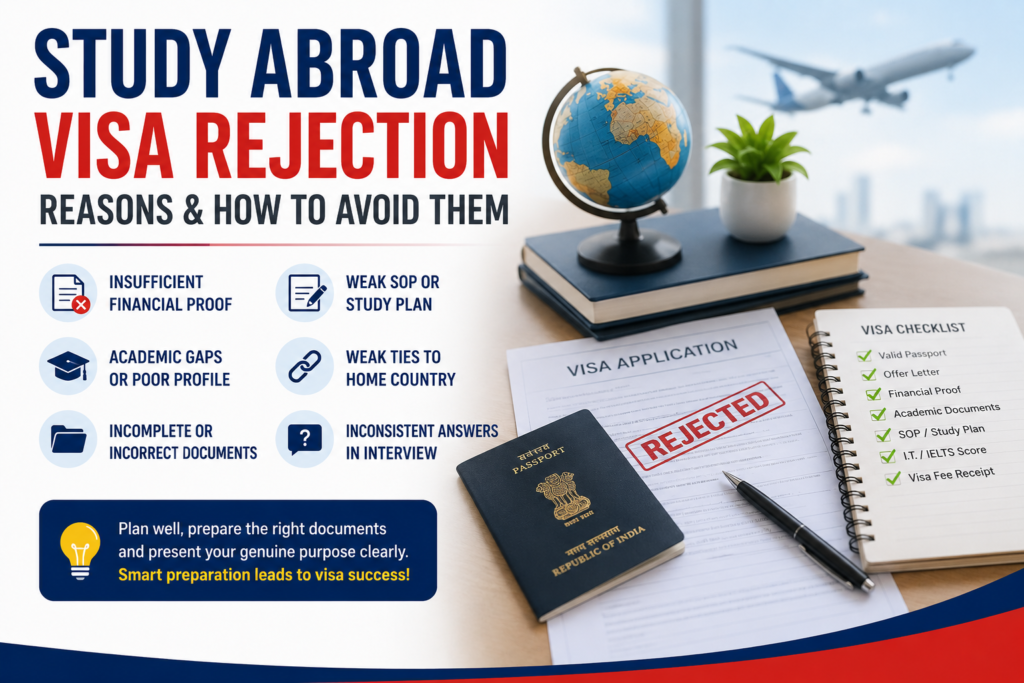
Studying abroad is a big dream for many Indian students. After choosing a university, preparing documents, writing an SOP, arranging finances and receiving an admission offer, the next major step is getting a student visa.
But what happens if your visa application is refused?
A study abroad visa rejection can be stressful and disappointing. However, a visa refusal does not always mean that your study abroad dream is over. In many cases, students can improve their application by understanding the reason for refusal and correcting the weak areas before applying again.
Visa officers check whether a student is a genuine student, has enough financial support, meets the visa requirements and has provided correct and consistent information. The exact requirements are different for every country.
This guide explains the most common student visa rejection reasons, how Indian students can avoid common mistakes and what they can do after a visa refusal.
Why Do Student Visas Get Rejected?
There is no single reason behind every visa rejection for Indian students. A refusal can happen because of financial problems, incomplete documents, an unclear study plan, inconsistent information, previous immigration history or failure to meet a country’s specific visa requirements.
Some common areas that students should pay close attention to are:
- Financial proof
- Study plans and genuine student requirements
- Academic history
- Study or employment gaps
- English-language requirements, where applicable
- Previous visa or immigration history
- Incorrect or incomplete documents
- Inconsistent answers during an interview
- Course and career mismatch
- Failure to meet country-specific visa requirements
Let’s understand these reasons in simple terms.
1. Insufficient or Unclear Financial Proof
One of the most important parts of a student visa application is proving that you can afford your education and living expenses.
Visa authorities want to see that you have access to genuine funds for your studies and stay. Depending on the country, acceptable evidence can include bank funds, education loans, scholarships or other approved financial support.
For example, Canada requires applicants to demonstrate sufficient financial support for tuition, living expenses and transportation.
Germany also allows students to demonstrate financial support through options such as parental finances, a declaration of commitment, a blocked account or certain scholarships.
Common mistakes include:
- Showing unexplained large deposits
- Providing incomplete bank documents
- Giving inconsistent information about the source of funds
- Depending on funds that are not genuinely available
- Not explaining an education loan properly
- Showing financial documents that do not meet the country’s current requirements
How to avoid it
Start your student visa financial requirements preparation early.
Keep proper records of your income and savings. If your education is being funded by your parents, be ready to explain the relationship and source of funds.
If you are using an education loan, keep the sanction letter and other supporting documents ready.
Most importantly, never create or manipulate financial documents just to meet a visa requirement.
2. Weak or Unclear Study Plan
Another important reason for a student visa refusal can be an unclear study plan.
A visa officer may want to understand:
- Why did you choose this course?
- Why did you choose this university?
- Why did you choose this country?
- How does the course connect with your previous education?
- What skills will you gain?
- How will the course support your future career?
Your answers should make sense as one complete story.
For example, if you studied commerce and suddenly choose a highly unrelated programme without explaining the reason for the change, the officer may have questions about your study plan.
How to avoid it
Prepare a clear study plan for student visa that explains your academic background, course choice and career goals.
Do not simply copy an SOP from the internet.
Your application should explain your own story.
3. Weak Statement of Purpose or Genuine Student Explanation
An SOP or visa statement should not be treated as a formality.
Different countries use different systems to assess whether a student genuinely intends to study.
For example, Australia uses the Genuine Student requirement. Applicants must explain their circumstances, why they want to study the selected course and provider, and how completing the course will benefit them. Australia also considers factors such as family, community, employment and economic circumstances.
The UK Student route also requires applicants to be genuine students.
Common mistakes:
❌ Using a generic SOP
❌ Giving unclear career goals
❌ Copying someone else’s answers
❌ Giving contradictory information
❌ Focusing only on working abroad
❌ Not explaining why the selected course is suitable
How to avoid it
Make sure your visa SOP is:
- Personal
- Clear
- Honest
- Consistent with your documents
- Connected to your education and career plans
4. Poor Academic Profile or Course Mismatch
Your academic history is another important part of your application.
A low percentage does not automatically mean visa rejection. However, you should be able to explain your academic journey honestly.
For example, an applicant with a bachelor’s degree in Business may need to clearly explain why they are now choosing a master’s programme in a different field.
Potential concerns can include:
- Major unexplained academic gaps
- Repeated failures
- Very low academic performance without explanation
- Choosing a course unrelated to previous studies
- Multiple changes in academic direction
How to avoid it
If there is a genuine reason behind your academic history, explain it clearly.
Do not hide gaps or provide false information.
A clear explanation supported by documents is much better than leaving the visa officer to guess what happened.
5. Unexplained Study or Employment Gaps
A study or work gap is not automatically a reason for visa rejection.
Students may have gaps because of:
- Preparing for competitive exams
- Employment
- Family responsibilities
- Health-related situations
- Skill development
- Financial reasons
- Career exploration
The important thing is that the timeline should be clear.
How to avoid visa problems because of gaps
Prepare supporting evidence wherever appropriate.
For example:
- Employment letters
- Salary slips
- Course certificates
- Internship certificates
- Exam preparation records
- Other relevant documents
Your explanation should also remain consistent across your university application, visa application and interview.
6. Incomplete or Incorrect Documents
One small documentation mistake can create unnecessary problems.
Before submitting your study abroad visa application, carefully check:
- Passport details
- Admission letter
- Financial documents
- Academic documents
- English-language documents, where required
- Health documents, where required
- Police or character documents, where required
- Sponsorship documents
- Loan documents
- Translations, where applicable
The UK, for example, lists a valid passport and CAS among the required student visa documents and may require financial evidence and other documents depending on the applicant’s circumstances.
Australia also advises applicants to use its document checklist and submit required evidence before lodging the application.
Best practice
Create a student visa document checklist and verify every document before submission.
Never submit a document simply because someone says it is “usually accepted.”
Always check the current official requirements for your country and visa type.
7. Inconsistent Information
Consistency is extremely important in a visa interview and visa application.
Suppose your application says that your parents are funding your education, but during the interview you say that you will pay everything yourself.
This creates confusion.
Similarly, your:
- SOP
- Application form
- Financial documents
- University application
- Interview answers
should not contradict each other.
How to avoid this problem
Read your complete application before the interview.
Know your:
- Course name
- University name
- Course duration
- Tuition fee
- Accommodation plan
- Funding source
- Career plans
- Previous education
Answer naturally and honestly.
8. Weak Understanding of Your Course or University
A student should know what they are going to study.
If a visa officer asks:
“Why did you choose this course?”
and the student cannot explain the course structure or its connection to their career, it may weaken the application.
Before your student visa interview, research:
- Course modules
- Course duration
- University location
- Tuition fees
- Career relevance
- Internship opportunities
- Academic facilities
- Why this university suits your goals
You do not need to memorise the university website.
You simply need to understand your decision.
9. Focusing Too Much on Working Abroad
International students may have access to legal work opportunities depending on their visa conditions and destination country.
However, the primary purpose of a student visa is study.
Australia’s current Genuine Student framework specifically requires applicants to demonstrate that studying is the primary reason for applying for the Student visa. It also recognises that genuine students may later pursue eligible pathways.
What should students do?
Talk about your education and career development first.
Do not present your study plan as:
“I am going abroad mainly because I want to work there.”
Instead, explain how the selected programme will help you gain knowledge, skills and international exposure relevant to your career.
10. Failing to Meet Country-Specific Visa Requirements
Every country has its own immigration rules.
Students should not use the same strategy for every destination.
USA
For an F-1 visa, applicants must qualify for the nonimmigrant visa category. Under INA Section 214(b), a refusal can occur if the applicant does not sufficiently demonstrate qualification or does not overcome the presumption of immigrant intent. The U.S. Department of State notes that ties can include employment, home and family or social relationships.
UK
The UK Student visa route includes a Genuine Student requirement and financial requirements. Applicants may need to show funds for course fees and living costs, depending on their circumstances.
Canada
Canada requires study permit applicants to demonstrate sufficient financial support for tuition, living expenses and transportation. For programmes longer than one year, applicants must also explain how they plan to finance the full period of study.
Australia
Australia uses the Genuine Student requirement and may require evidence of financial capacity. Applicants must also meet applicable health, character and other visa requirements.
Germany
Germany requires students to demonstrate that their studies and stay can be financially supported. Depending on the circumstances, this may include a blocked account, parental financial evidence, a declaration of commitment or an eligible scholarship.
Always check the latest official immigration requirements before submitting your application.
What Should You Do If Your Student Visa Is Rejected?
A visa refusal can feel like the end of your study abroad journey, but it does not necessarily mean that you cannot apply again.
The first step is to understand why your visa was rejected.
Step 1: Read the Refusal Letter
Carefully read the official refusal or decision notice.
Identify the exact concern mentioned by the visa authority.
Step 2: Do Not Submit the Same Application Again
One of the biggest mistakes students make is applying again with almost exactly the same documents and explanations.
If the original problem has not been corrected, the new application may face the same issue.
Step 3: Find the Weak Area
Ask:
- Was the financial evidence weak?
- Was the study plan unclear?
- Were documents incomplete?
- Was there inconsistent information?
- Was my academic progression unclear?
- Did I fail to meet a specific visa requirement?
Step 4: Improve the Application
Once you know the problem, work on that specific area.
For example:
Financial problem → improve and properly document the funding source.
Study-plan problem → explain the academic and career progression more clearly.
Documentation problem → provide the required documents in the correct format.
Gap problem → provide a clear and supported explanation.
Step 5: Consider Professional Guidance
If you are unsure about the refusal, consider getting your application reviewed by a qualified education or immigration professional.
A professional review can help identify inconsistencies or missing evidence.
However, no consultant can guarantee a student visa. The final decision belongs to the relevant immigration authority.
How to Avoid Student Visa Rejection: Final Checklist
Before submitting your application, ask yourself:
Financial Check
☑ Have I shown genuine and sufficient funds?
☑ Can I explain the source of my funds?
☑ Are my financial documents consistent?
Academic Check
☑ Does my course match my previous education or career plan?
☑ Have I explained my academic gaps?
☑ Can I clearly explain why I chose this programme?
Document Check
☑ Is my passport information correct?
☑ Are all required documents included?
☑ Are my documents genuine and consistent?
Interview Check
☑ Can I explain why I chose this university?
☑ Can I explain my career plans?
☑ Do I know my course and fees?
☑ Can I answer naturally without memorised answers?
Country Requirement Check
☑ Have I checked the latest official visa requirements?
☑ Have I checked the financial requirement?
☑ Have I checked the current visa application process?
Key Takeaways
- A student visa rejection does not always mean your study abroad dream is over.
- Financial evidence should be genuine, clear and properly documented.
- Your course choice should make sense with your academic and career background.
- Explain study gaps instead of hiding them.
- Keep information consistent across your application, documents and interview.
- Do not use fake documents or borrowed funds simply to show a higher bank balance.
- Understand the specific visa rules of your destination country.
- Australia and the UK currently use Genuine Student requirements, while the USA has its own nonimmigrant-intent framework for F-1 applicants.
- If your visa is refused, understand the reason before applying again.
- Never rely on a visa guarantee; the final decision is always made by the relevant immigration authority.
Frequently Asked Questions
1. What are the most common student visa rejection reasons?
Common issues include insufficient or unclear financial evidence, incomplete documents, inconsistent information, weak study plans, unexplained academic or employment gaps and failure to meet country-specific visa requirements.
2. Can I apply again after a student visa rejection?
In many situations, applicants can submit another application, but the rules and options depend on the destination country and the type of refusal. You should first understand the reason for the refusal and correct the relevant issue.
3. Can a low academic score cause visa rejection?
A low score does not automatically mean visa refusal. However, students should be able to explain their academic history and show that the selected course is a reasonable choice for their background and future plans.
4. Is a study gap a reason for visa rejection?
Not necessarily. A study or employment gap can have many genuine reasons. The important thing is to provide a clear explanation and supporting evidence where appropriate.
5. Can an education loan help with student visa financial proof?
An education loan can be part of the financial evidence where accepted under the destination country’s rules. The student should provide the required loan documentation and demonstrate access to the funds according to the applicable visa requirements.
6. Can I get a student visa if I have a weak financial profile?
It depends on the country’s requirements and your overall application. You need to demonstrate the required financial capacity using acceptable evidence. Do not rely on temporary or unexplained funds.
7. What should I do after a visa refusal?
Read the refusal carefully, identify the reason, review the original application and correct the specific weakness before considering a new application.
8. Is an SOP important for a student visa?
The exact format and requirements differ by country. Where a personal statement, study plan or Genuine Student response is required, it should clearly explain your academic background, course choice and future plans.
9. Can I work after getting a student visa?
Work rights depend on the destination country and your visa conditions. Students should always check the current official rules rather than assuming that work rights are the same everywhere.
10. Can a consultant guarantee my student visa?
No genuine consultant can guarantee a visa decision. Immigration authorities make the final decision based on the application and applicable rules.
Conclusion
A successful study abroad visa application is not only about having an admission letter. Your financial documents, academic history, course selection, study plan and overall information must create a clear and genuine picture.
The best way to reduce the risk of visa rejection is to prepare early, use genuine documents, understand the rules of your destination country and make sure every part of your application tells the same story.
If your visa has already been refused, do not simply submit the same application again. First understand what went wrong, correct the weakness and then decide your next step.
Plan carefully, prepare honestly and stay updated with official visa requirements for 2026.