Studying at an international university can be a life-changing experience for Indian students. It can provide access to better academic opportunities, international exposure, practical learning and global career options. However, the cost of studying abroad can be a major concern for students and their families.
Tuition fees, accommodation, food, travel, health insurance and other expenses can add up quickly. This is where an education loan for study abroad can help.
In 2026, Indian students can explore education loan options from banks and other financial institutions to help finance their international education. Depending on the lender, loan amount and student profile, an overseas education loan may cover tuition fees as well as selected living and education-related expenses.
This guide explains the education loan for Indian students, eligibility requirements, documents, application process, loan types, repayment and important points to consider before borrowing.
Why Should You Take an Education Loan for Studying Abroad?
An education loan for abroad studies can help students manage the cost of international education without paying the entire amount from family savings.
Instead of using all your family’s savings at once, an education loan allows you to spread the cost over a longer repayment period.
Main Benefits of an Education Loan
- Helps pay tuition fees
- Can cover eligible living expenses
- May cover accommodation and other approved costs
- Allows students to preserve family savings
- Provides flexible repayment options depending on the lender
- May provide tax benefits under Section 80E of the Income Tax Act, subject to applicable rules
- Can help students attend universities in countries such as the USA, UK, Canada, Australia, Germany and other study destinations
Important: The expenses covered, maximum loan amount, interest rate, collateral requirement and repayment period depend on the lender and loan product.
Types of Education Loans for Study Abroad
Students generally come across two main types of student loans for studying abroad: secured and unsecured loans.
1. Secured Education Loan
A secured loan requires the borrower to provide collateral.
Collateral may include:
- Residential property
- Land
- Fixed deposits
- Government securities
- Other assets accepted by the lender
Advantages
- Higher loan amounts may be available
- Interest rates may be more competitive
- Suitable for expensive international programmes
However, the exact terms depend on the lender and the value and type of collateral.
2. Unsecured Education Loan
An unsecured education loan does not normally require property or another asset as collateral.
The lender may assess factors such as:
- Student’s academic record
- University and course
- Admission status
- Co-applicant’s income
- Credit history
- Expected education expenses
Advantages
- No property collateral may be required
- Application can be simpler in eligible cases
- Useful for students who do not have suitable assets
However, unsecured loans can have higher interest rates or lower loan limits than some secured options.
Who Is Eligible for an Education Loan for Study Abroad?
Eligibility rules differ between lenders. However, students generally need to meet certain basic conditions.
Common requirements include:
- The applicant should generally be an Indian citizen
- The student should have secured admission to a recognised university or institution
- The selected course should be eligible under the lender’s policy
- The student should meet the required academic criteria
- A parent or eligible guardian is commonly required as a co-borrower
- The co-borrower may need to demonstrate sufficient income and a satisfactory credit profile
Some lenders may have additional age, course, institution, employment or collateral requirements.
Therefore, students should check the lender’s current eligibility criteria before applying.
Documents Required for an Education Loan
Having your documents ready can make the education loan application process easier.
Commonly required documents may include:
Student Documents
- Passport
- Aadhaar Card or other accepted identity proof
- PAN Card
- Academic certificates
- Marksheets/transcripts
- University admission or offer letter
- Course fee structure
- Passport-size photographs
Co-Applicant Documents
- Aadhaar or other KYC document
- PAN Card
- Income proof
- Salary slips, where applicable
- Income Tax Returns, where applicable
- Bank statements
- Employment or business proof
Collateral Documents
For secured loans, the lender may ask for:
- Property documents
- Valuation documents
- Ownership documents
- Fixed-deposit details
- Other security-related documents
The exact checklist varies by bank or financial institution.
How to Apply for an Education Loan for Study Abroad?
Getting an education loan for international studies becomes easier when you follow a planned process.
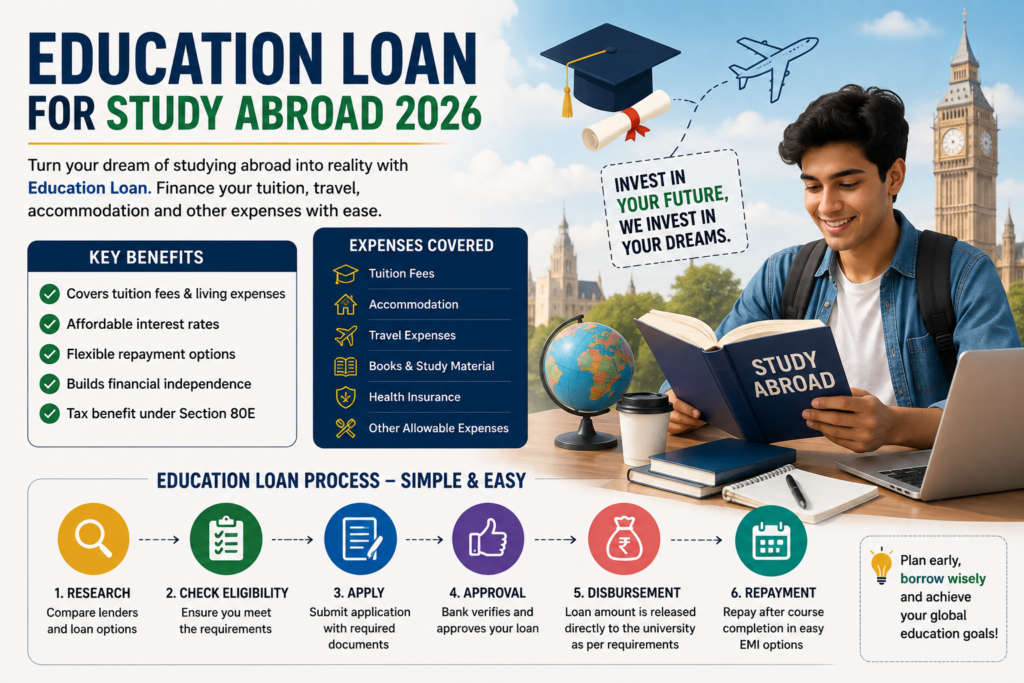
Step 1: Calculate Your Total Study Abroad Budget
Before applying, calculate the expected cost of:
- Tuition fees
- Accommodation
- Food
- Transportation
- Health insurance
- Visa expenses
- Travel
- Books and study materials
- Other personal expenses
This will help you decide how much funding you actually need.
Step 2: Research Different Lenders
Do not select a loan only because the lender advertises a low interest rate.
Compare:
- Interest rate
- Processing fee
- Maximum loan amount
- Collateral requirement
- Moratorium period
- Repayment period
- Prepayment conditions
- Expenses covered
- Disbursement process
You can compare options from banks and eligible financial institutions.
Step 3: Check Your Eligibility
Check whether your:
- University
- Course
- Academic profile
- Co-applicant
- Loan requirement
meet the lender’s conditions.
Step 4: Submit Your Application
Complete the study abroad loan application and submit the required documents.
The lender may verify your:
- Academic details
- Admission
- Course fees
- Co-applicant income
- Credit history
- Collateral, where applicable
Step 5: Loan Sanction
If the lender approves your application, you will receive a sanction or approval document containing the applicable loan terms.
Read it carefully before accepting the loan.
Pay particular attention to:
- Interest rate
- Repayment period
- Processing charges
- Moratorium
- Penal charges
- Insurance requirements
- Conditions for disbursement
Step 6: Loan Disbursement
After completing the required formalities, the approved amount may be disbursed according to the lender’s schedule.
In many cases, tuition fees are paid directly to the university, while approved living expenses may be released according to the loan agreement.
What Expenses Can an Education Loan Cover?
Depending on the lender and loan product, an education loan for overseas studies may cover several education-related expenses.
| Expense | May Be Covered? |
| Tuition fees | ✅ Generally |
| Examination fees | ✅ Depending on lender |
| Accommodation | ✅ Depending on lender |
| Books and study materials | ✅ Depending on lender |
| Travel expenses | ✅ Depending on lender |
| Health insurance | ✅ Depending on lender |
| Laptop/equipment | ✅ In some loan products |
| Other approved education expenses | ✅ Depending on lender |
Always check the individual lender’s terms because not every education loan covers every expense.
Education Loan Interest Rates in 2026
There is no single education loan interest rate applicable to every Indian student.
The rate can vary depending on:
- Lender
- Loan amount
- Secured or unsecured loan
- Collateral
- University and course
- Student profile
- Co-applicant’s credit history
- Applicable benchmark or lending structure
Some lenders may offer preferential rates for students admitted to selected universities or programmes.
Therefore, instead of focusing only on the advertised interest rate, compare the overall cost of the loan.
Ask the lender about:
- Current interest rate
- Fixed or floating rate
- Processing fee
- Prepayment charges
- Moratorium interest
- Late-payment charges
- Other applicable fees
What Is the Moratorium Period?
The education loan moratorium period is the period during which regular principal repayment generally does not begin.
Depending on the loan, the moratorium may cover:
Course duration + an additional period after completion
The exact duration varies between lenders.
Students should also ask an important question:
“Does interest continue to accumulate during the study and moratorium period?”
In many education loans, interest continues to accrue during this period. Understanding this before borrowing can help you estimate your total repayment amount.
Education Loan Repayment
After the applicable moratorium period ends, students generally begin repaying the loan through EMIs (Equated Monthly Instalments).
Your EMI can depend on:
- Total loan amount
- Interest rate
- Repayment period
- Interest accrued during the study period
- Other applicable charges
A longer repayment period can reduce the monthly EMI but may increase the total interest paid over the life of the loan.
Therefore, students should choose a repayment plan that is realistic for their expected income.
How to Improve Your Chances of Getting an Education Loan
There is no guaranteed way to get a loan approved, but you can improve your application by preparing properly.
1. Maintain a Good Academic Record
A strong academic history can support your overall profile.
2. Choose a Recognised University
The university and course can be important factors in a lender’s assessment.
3. Keep Your Documents Ready
Incomplete documentation can delay the process.
4. Maintain a Strong Co-Applicant Profile
The financial profile and credit history of the co-applicant may be important, especially for larger loans.
5. Apply Early
Do not wait until the last moment.
Start the education loan process after receiving your admission offer so that you have sufficient time for verification and disbursement.
Common Mistakes Students Should Avoid
❌ Choosing the First Loan Offer
Compare different lenders before making a decision.
❌ Looking Only at the Interest Rate
A slightly lower interest rate does not always mean a cheaper loan if other charges are high.
❌ Ignoring the Moratorium
Understand whether interest accumulates during your study period.
❌ Applying With Incomplete Documents
Check the lender’s complete document checklist.
❌ Borrowing More Than You Need
Calculate your actual funding requirement before deciding the loan amount.
❌ Not Understanding the Repayment Terms
Know when your EMI starts and how much you may need to repay.
Education Loan vs Using Personal Savings
Both options have advantages and disadvantages.
| Factor | Education Loan | Personal Savings |
| Immediate family savings | Preserved | Reduced |
| Interest cost | Applicable | No loan interest |
| Repayment | Required | Not required |
| Financial flexibility | Can preserve emergency funds | May reduce emergency savings |
| Tax benefits | Possible under applicable rules | Generally not applicable as a loan benefit |
| Credit impact | Depends on repayment | No loan involved |
A combination of savings and an education loan may also be suitable for some families.
Key Takeaways
- Education loans for study abroad can help Indian students manage the cost of international education.
- Secured loans generally require collateral, while unsecured loans may not.
- Your university, course, academic profile and co-applicant can influence loan eligibility.
- Compare education loan interest rates, processing fees, moratorium and repayment terms before choosing a lender.
- Prepare all documents in advance to avoid delays.
- Understand whether interest accumulates during the study and moratorium period.
- Borrow only the amount you realistically need.
- Start the loan process early, preferably soon after receiving your university admission.
- Always read the final loan agreement carefully before accepting the offer.