For many Indian students, studying abroad is not only about earning a degree. Students also want to gain international work experience, build a career and, in some cases, explore permanent residency (PR) options.
That is why the post-study work visa has become an important factor when choosing a study destination.
Visa rules have changed in several countries in 2026. Some destinations have tightened their rules, while others continue to offer good opportunities for international graduates.
So, before choosing a university, students should look beyond rankings and tuition fees. It is also important to understand the stay-back period, post-study work rights, skilled work visa options and PR pathway available after graduation.
Important: Immigration rules can change. The information below reflects the 2026 framework available from official sources and should be checked again before making a visa or study decision.
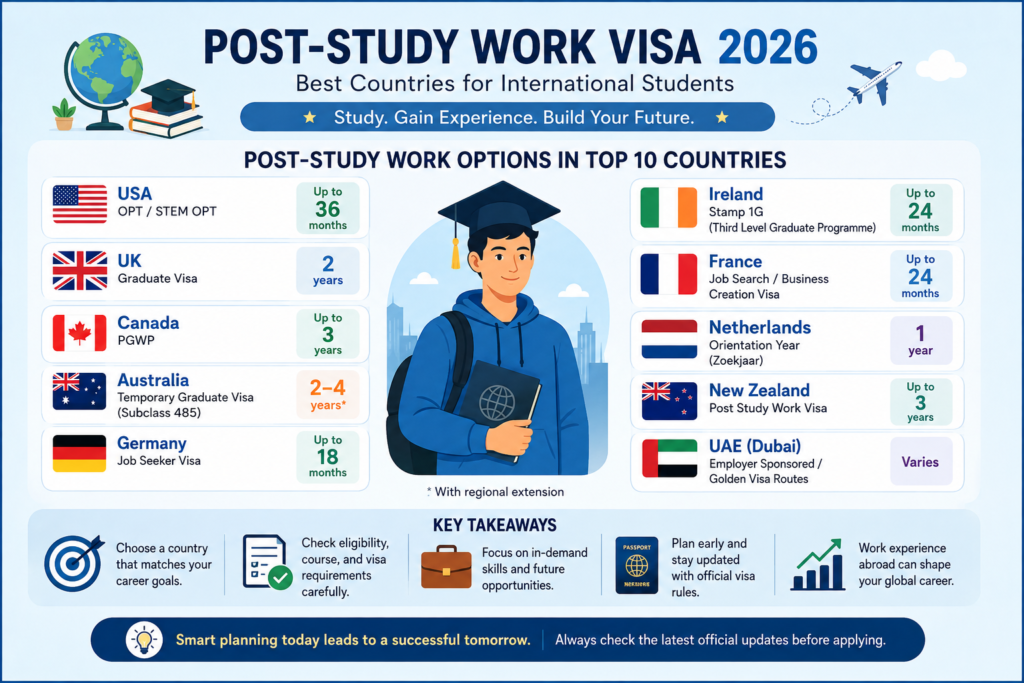
2026 Post-Study Work Visa Comparison
| Country | Main Post-Study Work Option | Typical Duration | Key Advantage |
| 🇺🇸 USA | OPT / STEM OPT | Up to 36 months for eligible STEM graduates | Strong opportunities in technology and specialised fields |
| 🇬🇧 UK | Graduate Visa | 2 years for applications by Dec 31, 2026 | No job offer required initially |
| 🇨🇦 Canada | PGWP | Up to 3 years, depending on eligibility | Strong pathway for eligible degree graduates |
| 🇦🇺 Australia | Temporary Graduate Visa (Subclass 485) | Usually 2–3 years; longer periods apply to some Indian graduates | Strong graduate work opportunities |
| 🇩🇪 Germany | Graduate job-search residence permit | Up to 18 months | Strong European job market |
| 🇮🇪 Ireland | Stamp 1G / Third Level Graduate Programme | Up to 24 months for eligible master’s graduates | Excellent technology and business sector |
| 🇫🇷 France | Job Search / Business Creation route | Subject to current eligibility and conditions | Opportunity to find work or start a business |
| 🇳🇱 Netherlands | Orientation Year (Zoekjaar) | 1 year | Flexible job-search period |
| 🇳🇿 New Zealand | Post Study Work Visa | Up to 3 years | Flexible work rights for eligible graduates |
| 🇦🇪 UAE | Employer-sponsored work / Golden Visa routes | Depends on visa category | Growing career opportunities and long-term residence options |
1. USA: Excellent Choice for STEM Graduates
The USA remains one of the strongest destinations for students interested in technology, engineering, data, finance and research.
The main post-study work option is Optional Practical Training (OPT).
Eligible F-1 students can generally receive up to 12 months of post-completion OPT. Students with qualifying STEM degrees may be able to receive an additional 24-month STEM OPT extension, giving them up to 36 months of practical training in total.
USA Post-Study Work Path
Graduation → 12-month OPT → 24-month STEM OPT → Potential employer-sponsored pathway
For STEM OPT, the degree must meet the applicable STEM requirements and the employer must satisfy requirements including participation in E-Verify.
Best suited for:
- Computer Science
- Artificial Intelligence
- Data Science
- Engineering
- Information Technology
- Biotechnology
- Quantitative fields
Key advantage: The USA can be particularly attractive for students targeting high-skilled careers.
2. UK: Graduate Visa Still Offers a Strong Short-Term Option
The UK remains a popular choice for Indian students because of its internationally recognised universities and shorter master’s programmes.
Under the current rules, students applying for the Graduate Visa on or before 31 December 2026 can stay for 2 years after completing an eligible course. From 1 January 2027, the standard Graduate Visa period for most eligible graduates will reduce to 18 months. PhD and other doctoral graduates continue to receive 3 years.
UK pathway:
UK degree → Graduate Visa → Skilled Worker route, if eligible
The Graduate Visa gives students time to work or look for work without needing to secure a sponsored job before applying for the Graduate route.
Best suited for:
- Business
- Finance
- Management
- Data Science
- Engineering
- Healthcare
- Computer Science
2026 tip: Students planning a September 2026 intake should understand the difference between the current 2-year rule and the 2027 change.
3. Canada: PGWP Rules Now Need Careful Planning
Canada continues to attract international students, but post-study work rights are now more dependent on the programme and student circumstances.
The Post-Graduation Work Permit (PGWP) can allow eligible graduates to work in Canada after completing their studies.
For graduates with a bachelor’s, master’s or doctoral degree, there is currently no field-of-study requirement, although language requirements apply. Other programmes may need to meet specific eligible-field requirements.
Canada has also maintained a 2026 freeze on its eligible field-of-study list for programmes where that requirement applies.
Canada pathway:
Study in Canada → PGWP → Canadian work experience → Possible immigration pathway
Important:
Do not select a Canadian college programme only because it is inexpensive. Always check whether the specific programme and institution are PGWP eligible before applying.
4. Australia: Strong Options for Indian Graduates
Australia continues to provide post-study work opportunities through the Temporary Graduate Visa (Subclass 485).
For the Post-Higher Education Work stream, the standard stay is generally 2–3 years, depending on the qualification. For Indian nationals, the Australia-India trade agreement provides longer periods for certain qualifications, including 3 years for eligible master’s graduates and 4 years for eligible doctoral graduates.
Students who studied and lived in eligible regional areas may also qualify for a second post-higher education work visa, generally providing an additional 1–2 years depending on the regional category.
Best suited for:
- Engineering
- IT
- Business
- Healthcare
- Data Science
- Education
Key advantage: Regional study can provide additional opportunities for eligible graduates.
5. Germany: One of Europe’s Strongest Stay-Back Options
Germany is an attractive destination for students looking for affordable education and strong employment opportunities.
After completing their studies, international graduates can generally receive a residence permit for up to 18 months to look for qualified employment. During this period, graduates can work while searching for a suitable job.
Once a graduate finds suitable employment, they may move to an appropriate work residence permit, such as an EU Blue Card, if they meet the requirements.
Germany pathway:
German degree → 18-month job search → Qualified employment → Work residence / EU Blue Card → Potential settlement
Best suited for:
- Mechanical Engineering
- Automotive Engineering
- Computer Science
- Data Science
- Electrical Engineering
- Engineering
- Renewable Energy
Why consider Germany?
It combines strong industrial demand with relatively affordable public higher education.
6. Ireland: Excellent for Technology and Business Careers
Ireland is home to many global technology, pharmaceutical and financial companies.
Eligible international graduates can use the Third Level Graduate Programme, commonly linked with Stamp 1G, to remain in Ireland after completing their studies.
For eligible master’s-level graduates, the post-study period can extend to 24 months.
The long-term goal for many graduates is to move from graduate permission to an appropriate employment permit, such as the Critical Skills Employment Permit, if they meet the requirements.
Best suited for:
- Computer Science
- Cybersecurity
- Data Analytics
- Finance
- Business
- Pharmaceutical Sciences
- Artificial Intelligence
7. France: Study, Work or Explore Business Opportunities
France is becoming increasingly attractive for international students looking for affordable European education and career opportunities.
Eligible graduates with a master’s-level qualification can use France’s Job Search / Business Creation route subject to the applicable requirements. The route is designed for graduates who want to return to France to search for employment or establish a business.
Best suited for:
- Business Management
- Luxury Management
- Fashion
- Engineering
- Finance
- Hospitality
- Data and Technology
8. Netherlands: One-Year Orientation Year
The Netherlands offers the Orientation Year residence permit, commonly called the Zoekjaar.
It gives eligible graduates one year to look for employment or start a business in the Netherlands. The permit cannot simply be extended, but graduates who secure suitable employment can switch to another residence route, such as the highly skilled migrant route.
International graduates from qualifying foreign institutions may also be eligible under specific ranking and qualification conditions.
A major benefit is the reduced salary criterion that can apply to eligible graduates moving into highly skilled migrant employment. In 2026, the reduced criterion is €3,122 gross per month, subject to the applicable rules.
9. New Zealand: Up to 3 Years for Eligible Graduates
New Zealand offers a Post Study Work Visa for eligible international graduates.
Depending on the qualification and study conditions, graduates may be able to stay and work in New Zealand for up to 3 years.
New Zealand is also introducing further graduate work options in November 2026, including a new short-term graduate work visa for eligible graduates.
Best suited for:
- Engineering
- IT
- Agriculture
- Healthcare
- Construction
- Business
- Environmental studies
10. UAE: Different Model from Traditional Post-Study Work Visas
The UAE works differently from countries such as Canada, Australia or Germany.
Students generally move into employment through an appropriate employment/residence visa rather than a traditional long post-study open work visa.
The UAE also offers a jobseeker visit visa for eligible applicants, allowing 60, 90 or 120 days to look for employment without a host or sponsor. Eligibility includes factors such as qualification level and, for some applicants, graduation from a highly ranked university.
Outstanding university students may also qualify for the UAE Golden Visa, with top university students potentially eligible for a 10-year residence visa subject to the applicable criteria.
Best suited for:
- Business
- Finance
- Hospitality
- Marketing
- IT
- Engineering
- Logistics
Which Country Has the Best Post-Study Work Visa in 2026?
There is no single best country for every student.
Your best choice depends on your:
- Course
- University
- Budget
- Career goal
- Work experience
- Preferred country
- Demand for your occupation
- Long-term immigration plans
Quick guide
| Your Priority | Countries Worth Considering |
| STEM career | USA, Germany, Australia |
| Affordable European education | Germany, France |
| Technology jobs | USA, Ireland, Germany, Netherlands |
| Longer post-study work options | Australia, Canada, New Zealand |
| European career | Germany, Ireland, Netherlands, France |
| Business & finance | UK, USA, Ireland, UAE |
| Regional work opportunities | Australia |
| Long-term settlement planning | Germany, Canada, Australia, Ireland |
How to Choose the Right Country in 2026?
Don’t choose a country only because it offers a long stay-back visa.
Use this simple checklist:
1. Check your course
Is your course connected to jobs that are in demand?
2. Check work rights
Understand exactly how long you can stay after graduation.
3. Check eligibility
Some countries have specific rules based on your qualification, institution, field of study or nationality.
4. Research the job market
A 3-year work visa is not useful if there are limited jobs in your field.
5. Understand salary requirements
Some work visas require you to earn a minimum salary.
6. Look at PR options
If permanent residency is your goal, understand the skilled migration and settlement rules before choosing your destination.
7. Calculate the total cost
Compare tuition fees, accommodation, insurance, travel and living expenses with expected career opportunities.
Key Takeaways
✅ Post-study work opportunities have become an important part of study-abroad planning in 2026.
✅ USA remains particularly attractive for eligible STEM students because OPT can reach up to 36 months.
✅ Australia offers strong post-study opportunities, with special provisions for eligible Indian graduates.
✅ Germany provides an 18-month period to search for qualified employment after graduation.
✅ Canada still offers PGWP opportunities, but students must carefully check current eligibility rules.
✅ UK Graduate Visa rules are changing, with 2 years for eligible applications by December 31, 2026, and 18 months for applications from January 1, 2027.
✅ Netherlands offers a 1-year Orientation Year with a possible transition to highly skilled employment.
✅ New Zealand can offer up to 3 years of post-study work rights for eligible graduates.
The biggest lesson: Don’t choose a study destination only for its university ranking. Choose a country where your education + skills + career plan + post-study work rights work together.