Singapore may be small on the map, but for an Indian student thinking globally, it can offer a very different kind of international education experience.Imagine finishing your morning classes, grabbing an affordable meal at a hawker centre, travelling across the city by MRT, meeting classmates from different countries, and developing skills in one of Asia’s major business and education hubs.For Indian students considering a Diploma, Bachelor’s degree or Master’s degree abroad, Singapore deserves serious consideration. It combines modern infrastructure, multicultural living, English-friendly education and close proximity to India. Singapore’s Ministry of Foreign Affairs describes the country as a multicultural society shaped particularly by Chinese, Malay, Indian and Eurasian communities, with an integrated transport network and strong international business environment.
Here’s what you should know before making your decision.
Why Study in Singapore from India?
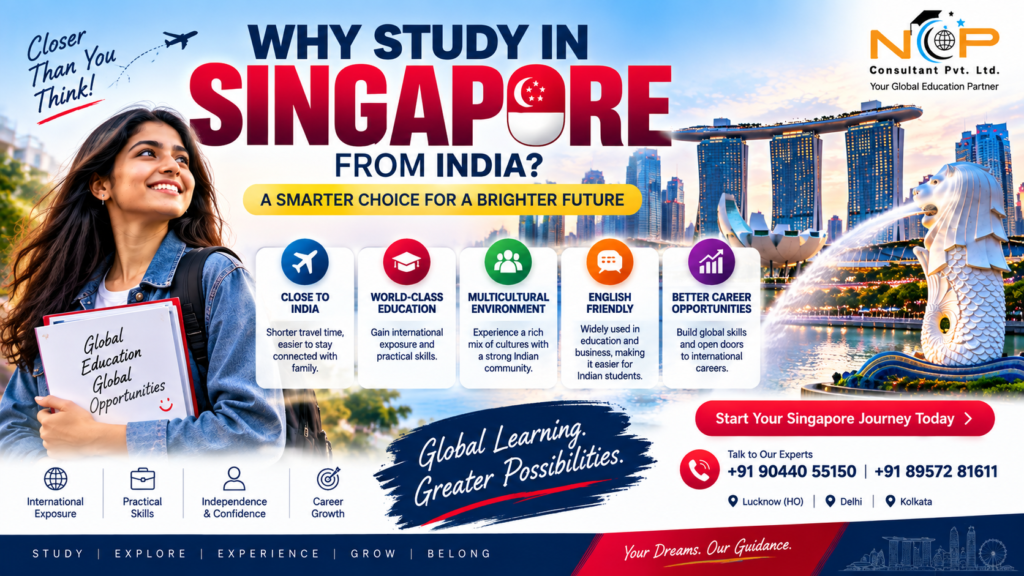
For many Indian families, studying abroad isn’t simply about earning a foreign qualification. Students want international exposure, practical skills, independence and career development, while parents understandably look at factors such as the education provider, total cost, living environment and future opportunities.Singapore brings several of these considerations together.One major advantage is location. Compared with many Western study destinations, Singapore is relatively close to India, making travelling home more manageable.The country is also highly multicultural. Indian students can experience a genuinely international environment without being completely disconnected from familiar food, festivals and communities. Singapore’s cultural landscape includes a substantial Indian influence alongside Chinese, Malay and other cultures.English is also widely used in education and business, which can make everyday academic and professional communication easier for many Indian students.
What Is Student Life in Singapore Like?
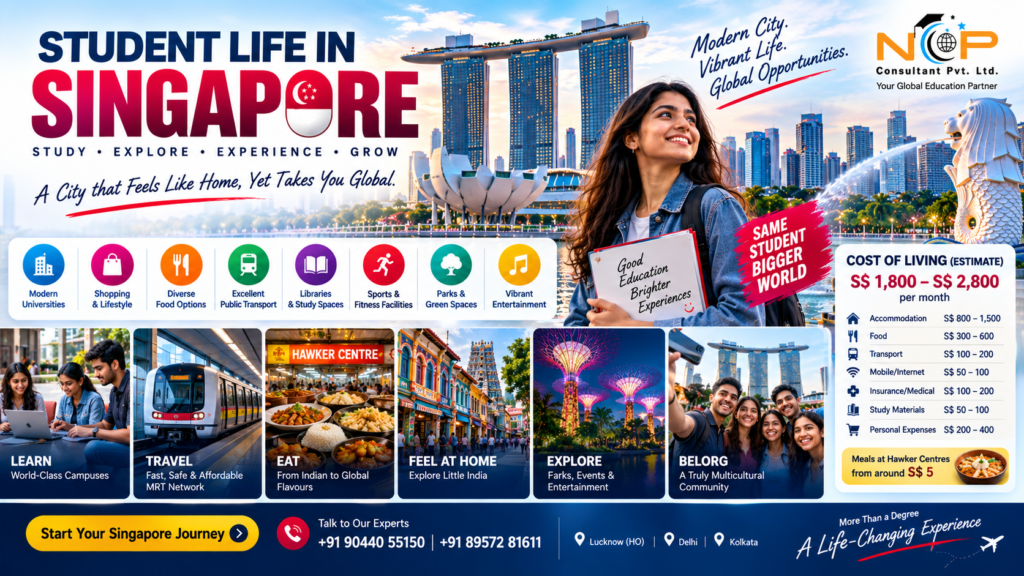
One of Singapore’s strongest attractions is the experience outside the classroom.Students can expect a highly urban environment with universities, shopping areas, food courts, libraries, sports facilities, public parks, entertainment districts and extensive public transportation.Singapore’s integrated public transport system makes it possible to move around the city without owning a vehicle.And then there’s the food.From Indian and South Indian food to Chinese, Malay and international cuisines, students have plenty of choice. Hawker centres are particularly important to Singapore’s everyday food culture and can provide more budget-friendly alternatives to restaurants.For many Indian students, places such as Little India can provide a taste of home while the rest of Singapore offers an opportunity to experience cultures from across Asia.
How much does student life cost?
Living expenses depend heavily on your accommodation and lifestyle. A 2026 guide from NUS Business School estimates that international students may spend roughly S$1,800–S$2,800 per month, with costs potentially rising substantially for students choosing private studios/condos or eating out frequently. It also gives the example of meals around S$5 at some hawker centres.Students should therefore budget separately for accommodation, food, transport, mobile/internet, insurance/medical expenses, study materials and personal spending.
Singapore Currency: What Indian Students Should Know 💰
Singapore uses the Singapore Dollar (SGD or S$).
Indian families should avoid planning an entire degree using one fixed SGD-to-INR conversion because exchange rates change continuously. Tuition and living costs should therefore be calculated in Singapore dollars first, with an additional buffer for exchange-rate movement.For example, if a course costs S$6,225, calculate its current rupee equivalent when you’re actually budgeting or transferring money rather than relying on an old advertisement or exchange rate.This is especially important for longer Bachelor’s and Master’s programmes where payments may be spread across multiple semesters or years.
Which Courses Should Indian Students Consider in Singapore? 🎓
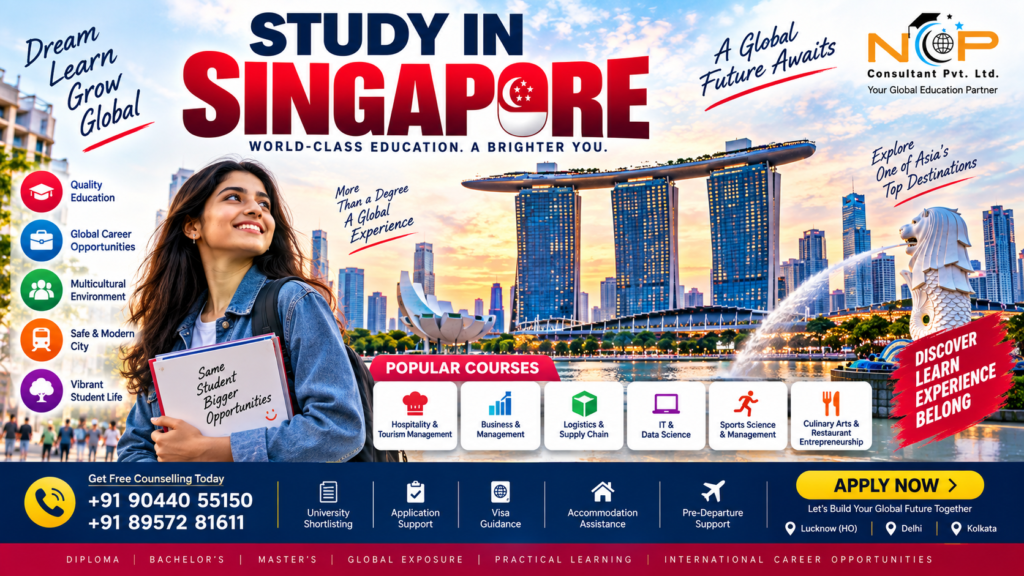
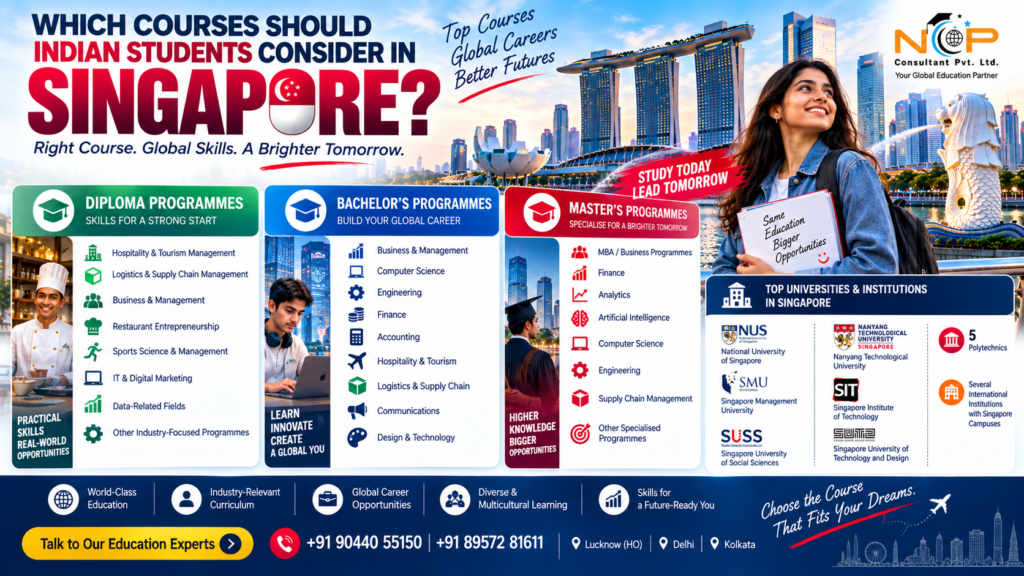
There isn’t one “best” course for everyone. Your choice should depend on your previous education, interests, career plans, budget, institution and the recognition of the qualification.For Diploma programmes, students may explore areas such as hospitality and tourism management, logistics and supply chain management, business and management, restaurant entrepreneurship, sports science and management, IT, digital marketing, data-related fields and other vocational or industry-focused programmes.At Bachelor’s level, common areas worth researching include business and management, computer science, engineering, finance, accounting, hospitality, logistics, communications, design and technology.At Master’s level, students may explore MBA/business programmes, finance, analytics, artificial intelligence, computer science, engineering, supply-chain management and other specialised postgraduate programmes.Singapore has six local universities listed by ICA for Student’s Pass purposes: National University of Singapore, Nanyang Technological University, Singapore Management University, Singapore Institute of Technology, Singapore University of Social Sciences and Singapore University of Technology and Design. ICA also lists five local polytechnics and several offshore institutions with Singapore campuses.The important question isn’t simply “Which course is popular?”Ask:
“Which course fits my academic background and gives me skills relevant to the career I actually want?”
Can Indian Students Work Part-Time in Singapore? 💼
This is one area where students need to be especially careful because there is a lot of misleading marketing online.Having a Singapore Student’s Pass does not automatically mean every international student can take any part-time job.Singapore’s Ministry of Manpower states that eligible full-time students holding an ICA Student’s Pass and studying at one of MOM’s specifically listed institutions can work during the school term without a separate work pass for up to 16 hours per week, or undertake qualifying industrial attachments/internships that form part of their programme requirements. MOM also sets separate conditions for work during vacations.This means a student studying at a private institution should not assume that the “16 hours per week” rule automatically applies to them.Before accepting any job, check whether your institution appears on MOM’s current eligible list and whether your proposed work meets the conditions.Potential student jobs in a city like Singapore can exist in areas such as retail, food and beverage, administrative support, events and customer service, but your legal eligibility to perform that work depends on Singapore’s employment and immigration rules.Once your studies are completed and your Student’s Pass expires, MOM states that you will need the appropriate work pass to continue working in Singapore, with the employer applying where required.So treat part-time employment as a possible supplement where legally permitted—not as a guaranteed way to finance tuition and living expenses.
Paid Internships: An Important Difference
A paid internship included in an academic programme is not necessarily the same thing as taking an independent part-time job.MOM allows qualifying industrial attachments/internships under specific conditions, including where they form part of graduation requirements at eligible institutions.Therefore, whenever an institution or consultant advertises a programme with a “paid internship,” students should ask for the details in writing:Is the internship guaranteed or subject to selection? Who arranges it? Is it part of the curriculum? What is the expected remuneration? Is every international student legally eligible? What happens if a placement isn’t available?Those questions are more valuable than relying on a promotional headline alone.
Singapore Student Visa: Understanding the Student’s Pass 🛂
For most international students pursuing full-time education, the important immigration document is Singapore’s Student’s Pass.ICA states that a foreign student accepted into an educational institution for full-time study generally needs a Student’s Pass unless they hold another qualifying immigration status. The course must be an approved full-time course; part-time, evening and weekend courses are not eligible for a Student’s Pass.For Institutes of Higher Learning, ICA currently advises applications to be submitted online at least two months and not more than three months before the course begins. ICA lists a non-refundable processing fee of S$45 and says processing is generally within one week, or within two weeks where a visa is required, although some cases can take longer.Student’s Passes are issued digitally rather than as physical cards.
Studying at a Private College? Check This Before Paying Fees ⚠️
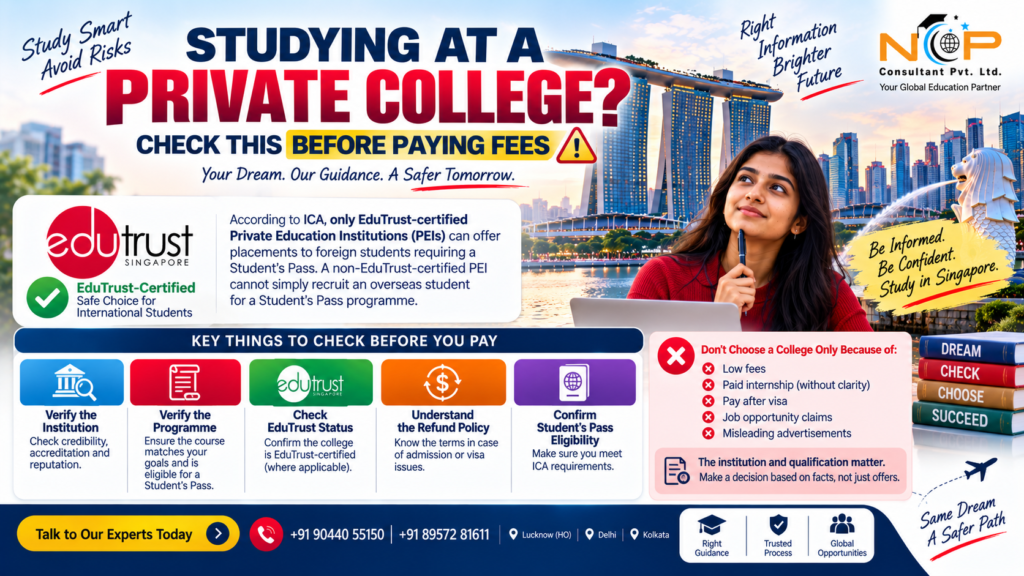
This step is extremely important for Indian students considering private diploma or degree providers.ICA states that only EduTrust-certified Private Education Institutions can offer placements to foreign students requiring a Student’s Pass. A non-EduTrust-certified PEI cannot simply recruit an overseas student for a Student’s Pass programme.Therefore, before paying a substantial deposit:Verify the institution, verify the programme, check EduTrust status where applicable, understand the refund policy, and confirm Student’s Pass eligibility.Do not select a college only because an advertisement says “low fees,” “paid internship,” “pay after visa” or “job opportunity.”The institution and qualification matter.
Documents You May Need for a Student’s Pass
Exact requirements depend on your institution and circumstances. For Institutes of Higher Learning, ICA lists information/documents including the school’s Registration Acknowledgement Letter, travel-document biodata page, educational background, employment history, financial-support information, family information where applicable, Singapore residential/contact details, email address and a recent digital passport-size photograph.Applications should be truthful and consistent. Differences in academic history, finances, employment information or documentation can create complications.ICA also makes an important distinction between an entry visa and an immigration pass: a Singapore entry visa is pre-entry permission to travel to and seek entry into Singapore; it does not itself guarantee entry.
Accommodation: Where Do Students Live? 🏠
Depending on their institution, budget and availability, international students may consider:University/college accommodation where available, private student accommodation, shared apartments, rented rooms, hostels or private apartments/condominiums.Shared accommodation is often more economical than renting an entire apartment alone.Before signing a rental agreement, students should understand deposits, utility charges, minimum rental periods, house rules, commuting distance and what is actually included in the rent.A cheap room located far from campus can sometimes cost you more in commuting time and convenience.
Culture: Will an Indian Student Feel at Home? 🇮🇳🤝🇸🇬
Singapore’s multicultural character is one reason it can feel approachable for Indian students.Chinese, Malay, Indian and Eurasian influences are visible across the country’s food, festivals, languages, neighbourhoods and religious traditions.At the same time, studying there means adapting to another country’s expectations and social norms.Students should be prepared to be punctual, respect local regulations, maintain appropriate behaviour in public spaces and learn to work with classmates from different cultures.That adaptation itself is part of studying abroad.
What About Safety, Healthcare and Everyday Convenience?
Singapore offers highly developed urban infrastructure, extensive public transport and a compact geography.International students should nevertheless plan for medical expenses and understand the insurance provided or required by their institution. They should also keep emergency funds rather than assuming part-time earnings will cover unexpected expenses.A sensible student budget should contain a buffer for medical care, flights home, deposits, books/equipment and emergencies.
Diploma vs Bachelor’s vs Master’s — Which Route Makes Sense?
Diploma: Often attractive to students looking for shorter, skills-oriented programmes. Before enrolling, investigate the awarding body, progression possibilities and recognition.
Bachelor’s: Better suited to students looking for a comprehensive undergraduate qualification after Class 12. Compare programme length, curriculum, institution, tuition, internships and progression opportunities.
Master’s: Designed for graduates seeking specialised postgraduate knowledge. Look closely at entry requirements, professional relevance, industry connections and return on the total investment.
Never choose the qualification level merely because it provides the quickest route overseas.Choose it because it makes sense for your education and career trajectory.
Why Singapore Can Be Attractive to Indian Parents Too
Parents often evaluate studying abroad differently from students.
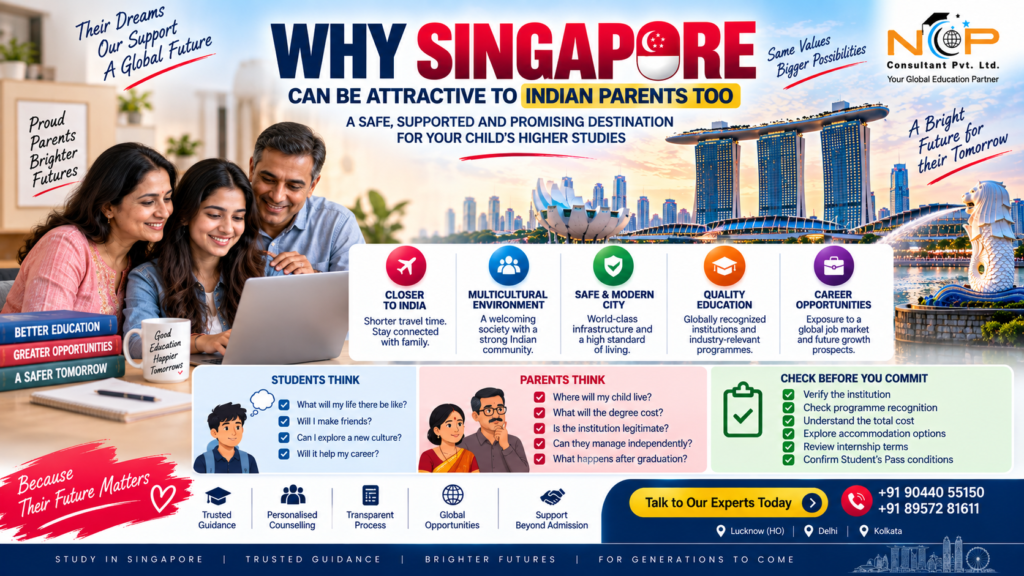
Students may think:
“What will my life there be like?”
Parents may think:
“Where will my child live? What will the degree cost? Is the institution legitimate? Can they manage independently? What happens after graduation?”
Singapore’s proximity to India, multicultural environment, extensive public infrastructure and established education system can make it an option worth evaluating as a family.
But parents should participate in checking the institution, programme recognition, total cost, accommodation, internship terms and Student’s Pass conditions before committing funds.
Before You Apply: Your Singapore Checklist 🇸🇬
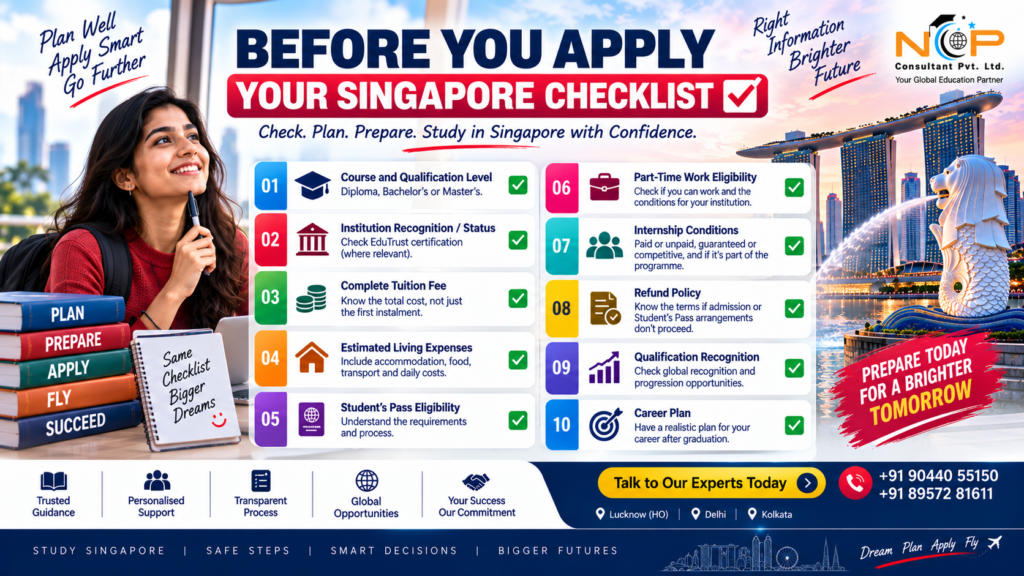
Before making your final decision, verify these points:
- Course and qualification level — Diploma, Bachelor’s or Master’s.
- Institution recognition/status — particularly EduTrust certification where relevant.
- Complete tuition fee — not merely the first instalment.
- Estimated living expenses — including accommodation.
- Student’s Pass eligibility and requirements.
- Part-time work eligibility for your specific institution.
- Internship conditions — paid/unpaid, guaranteed/competitive and whether it forms part of the programme.
- Refund policy if admission or Student’s Pass arrangements don’t proceed as expected.
- Qualification recognition and progression opportunities.
- Your realistic career plan after graduation.
Singapore Is More Than a Study Destination — It Can Be a Global Learning Experience 🌏
Studying abroad changes much more than the name printed on your qualification.
You learn to manage your own budget.
You meet people from different countries.
You learn to navigate a new city.
You become responsible for your own deadlines, decisions and future.
And you begin looking at your career from an international perspective.
For Indian students who want to pursue a Diploma, Bachelor’s or Master’s programme, Singapore offers a combination of international education, multicultural living, modern infrastructure and access to one of Asia’s major commercial environments.
But the smartest international student doesn’t simply ask:
“How quickly can I go abroad?”
They ask:
“Which programme can take me closer to the career and life I want to build?”
That is where the right study-abroad journey begins.