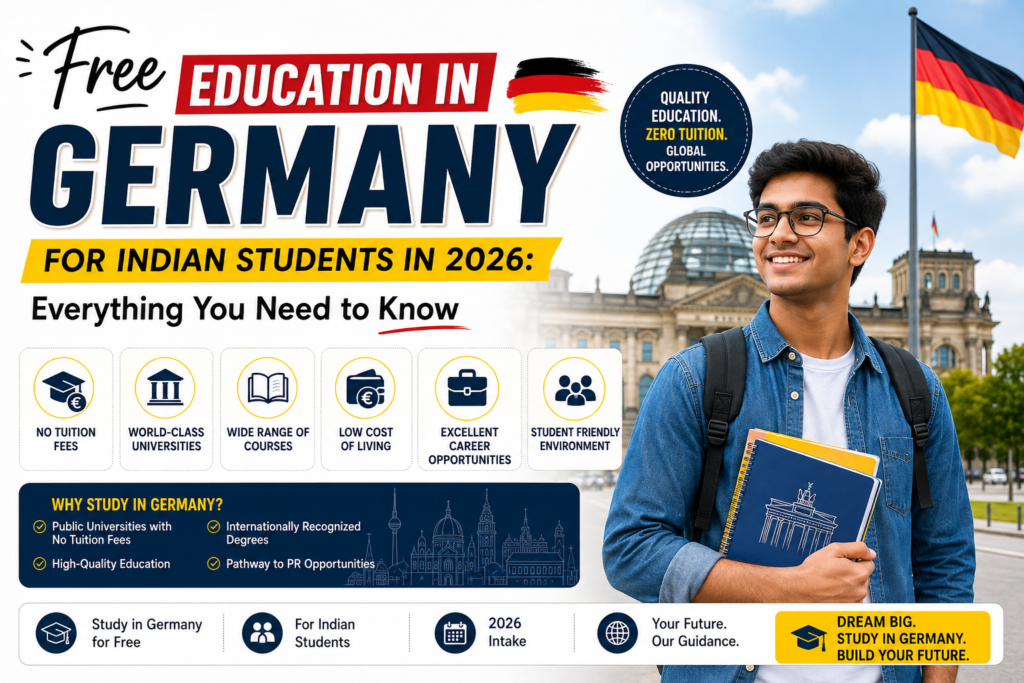
Germany has become one of the most popular study abroad destinations for Indian students. Every year, thousands of students choose Germany because of its world-class education, affordable living costs, globally recognized degrees, and tuition-free public universities.
If you dream of studying in Europe but worry about high tuition fees, Germany could be the perfect destination for you.
One of the biggest reasons students choose Germany is that most public universities do not charge tuition fees, even for international students. Instead of paying thousands of euros every year, students usually pay only a small semester contribution that covers administrative services and public transportation.
In recent years, Germany has welcomed a record number of Indian students. According to the latest available data, over 49,000 Indian students are studying in Germany, making India one of the largest international student communities in the country.
Whether you want to study Engineering, Computer Science, Artificial Intelligence, Data Science, Business, Management, Biotechnology, Economics, or Renewable Energy, Germany offers thousands of English-taught and German-taught programmes.
This comprehensive guide explains everything Indian students need to know about studying in Germany for free in 2026, including eligibility, admission requirements, and the application process.
Why Choose Germany for Higher Education?
Germany has built a strong reputation for providing high-quality education while keeping higher education affordable.
Unlike many countries where students spend lakhs of rupees every year on tuition fees, Germany believes education should be accessible to everyone.
Here are the biggest reasons why students prefer Germany.
1. Tuition-Free Public Universities
The biggest advantage is that most public universities charge no tuition fees for Bachelor’s and many consecutive Master’s programmes.
Students only pay a semester contribution, which usually ranges between €150 and €350 per semester.
This makes Germany one of the most affordable countries for international students.
2. Globally Recognised Degrees
German university degrees are accepted and respected worldwide.
Graduates from German universities work in leading multinational companies such as:
- BMW
- Mercedes-Benz
- Bosch
- Siemens
- SAP
- Volkswagen
- Audi
- Amazon
- Microsoft
A German qualification also opens doors to career opportunities across Europe and other countries.
3. Excellent Education Quality
Germany has more than 400 universities, including many institutions ranked among the world’s top universities.
Students receive:
- Practical learning
- Industry-focused education
- Modern laboratories
- Advanced research facilities
- International exposure
4. Strong Economy and Career Opportunities
Germany has Europe’s largest economy.
The country offers excellent opportunities in sectors such as:
- Engineering
- Artificial Intelligence
- Information Technology
- Automobile
- Manufacturing
- Healthcare
- Renewable Energy
- Finance
Many students stay in Germany after graduation through the Post-Study Work Visa.
5. Affordable Cost of Living
Compared to countries like the USA, UK, Australia, and Canada, Germany offers a relatively affordable lifestyle.
Students can manage their monthly expenses through careful budgeting and part-time jobs.
6. International Student-Friendly Environment
Germany welcomes students from more than 180 countries.
Universities provide:
- International student support
- Orientation programmes
- Language assistance
- Career guidance
- Student clubs and communities
This makes it easier for international students to adjust to life in Germany.
Is Education Really Free in Germany?
One of the most common questions students ask is:
“Is education completely free in Germany?”
The answer is Yes—but with some exceptions.
Most public universities in Germany do not charge tuition fees for domestic or international students.
Instead, students pay only a Semester Contribution, which generally includes:
- Student services
- Administration charges
- Student union fees
- Public transportation pass
The semester contribution usually ranges between €150 and €350.
This amount is much lower than tuition fees charged by universities in countries such as Canada, Australia, or the United Kingdom.
Who Can Study for Free?
Tuition-free education is available to:
- German students
- European Union (EU) students
- International students
- Indian students
Nationality does not usually affect tuition at public universities.
Are There Any Exceptions?
Yes.
Some situations where tuition fees may apply include:
- Private universities
- Executive MBA programmes
- Non-consecutive Master’s programmes
- Certain specialised courses
- Some universities in Baden-Württemberg for selected non-EU students
Even then, tuition fees are often lower than in many other popular study destinations.
Understanding the German Education System
Germany has one of the strongest higher education systems in the world.
Students can choose from different types of institutions depending on their career goals.
| Institution | Best For |
| Public Universities | Academic degrees, research |
| Universities of Applied Sciences | Practical and industry-focused learning |
| Technical Universities | Engineering and Technology |
| Private Universities | Specialized programmes |
| Colleges of Art & Music | Creative fields |
Bachelor’s Degree in Germany
The education systems in India and Germany are different.
Indian students complete 12 years of schooling, while Germany generally requires 13 years before university.
Because of this difference, some Indian students may need to complete a Foundation Course (Studienkolleg) before starting a Bachelor’s degree.
Bachelor’s Programme Duration
- 3 to 4 years
- 6–8 semesters
Popular Bachelor’s courses include:
- Computer Science
- Mechanical Engineering
- Artificial Intelligence
- Business Management
- Economics
- Biotechnology
Master’s Degree in Germany
Master’s programmes usually take:
- 1–2 years
- 2–4 semesters
Students can choose from thousands of English-taught Master’s programmes.
Popular Master’s fields include:
- Data Science
- Artificial Intelligence
- Cyber Security
- Supply Chain Management
- International Business
- Renewable Energy
- Mechanical Engineering
Eligibility Criteria for Free Education in Germany (2026)
Before applying, students must ensure they meet the university’s admission requirements.
Although requirements vary by university and programme, most institutions ask for the following.
Academic Qualifications
For Bachelor’s programmes:
- Class 12 qualification
- Good academic performance
- Additional foundation programme if required
For Master’s programmes:
- Recognized Bachelor’s degree
- Minimum academic percentage or CGPA (varies by university)
English Language Proficiency
Most English-taught programmes require one of the following:
- IELTS
- TOEFL
- PTE Academic
Some universities may waive this requirement if previous education was completed entirely in English.
German Language Requirements
If the course is taught in German, students may need certificates such as:
- TestDaF
- DSH
- Goethe Certificate
Standardized Tests (If Required)
Certain universities or programmes may ask for:
- GRE
- GMAT
This requirement mainly applies to competitive Master’s programmes.
Documents Required
Students usually need:
- Academic transcripts
- Degree certificates
- Passport
- Statement of Purpose (SOP)
- Letters of Recommendation (LORs)
- Updated Resume/CV
- English language test score
- Passport-size photographs
Step-by-Step Admission Process for Indian Students
Studying in Germany becomes much easier when you understand the admission process.
Step 1: Choose Your Course
Research universities carefully.
Consider:
- Course curriculum
- University ranking
- Tuition policy
- Career opportunities
- Language of instruction
Step 2: Shortlist Universities
Compare universities based on:
- QS Rankings
- Location
- Living expenses
- Research opportunities
- Internship options
Step 3: Prepare Required Documents
Collect all academic and supporting documents before application deadlines.
Ensure every document is properly scanned and translated if required.
Step 4: Submit University Applications
Most German universities accept online applications directly through their admission portals or through uni-assist (where applicable).
Always check individual university deadlines.
Step 5: Receive Admission Letter
If selected, the university will issue an Admission Letter (Offer Letter).
This document is required for your student visa application.
Step 6: Apply for a German Student Visa
After receiving admission, students should begin their visa application.
The visa process generally requires:
- Admission letter
- Passport
- Proof of financial resources
- Health insurance
- Academic documents
- Visa application forms
Key Takeaways
✅ Germany is one of the best countries for affordable higher education.
✅ Most public universities offer tuition-free education to Indian and international students.
✅ Students usually pay only a semester contribution instead of tuition fees.
✅ Germany offers world-class education, excellent research facilities, and strong career opportunities.
✅ More than 49,000 Indian students are currently studying in Germany.
✅ Students should carefully check eligibility requirements, language proficiency, and university admission criteria before applying.